What is Trap Shooting?
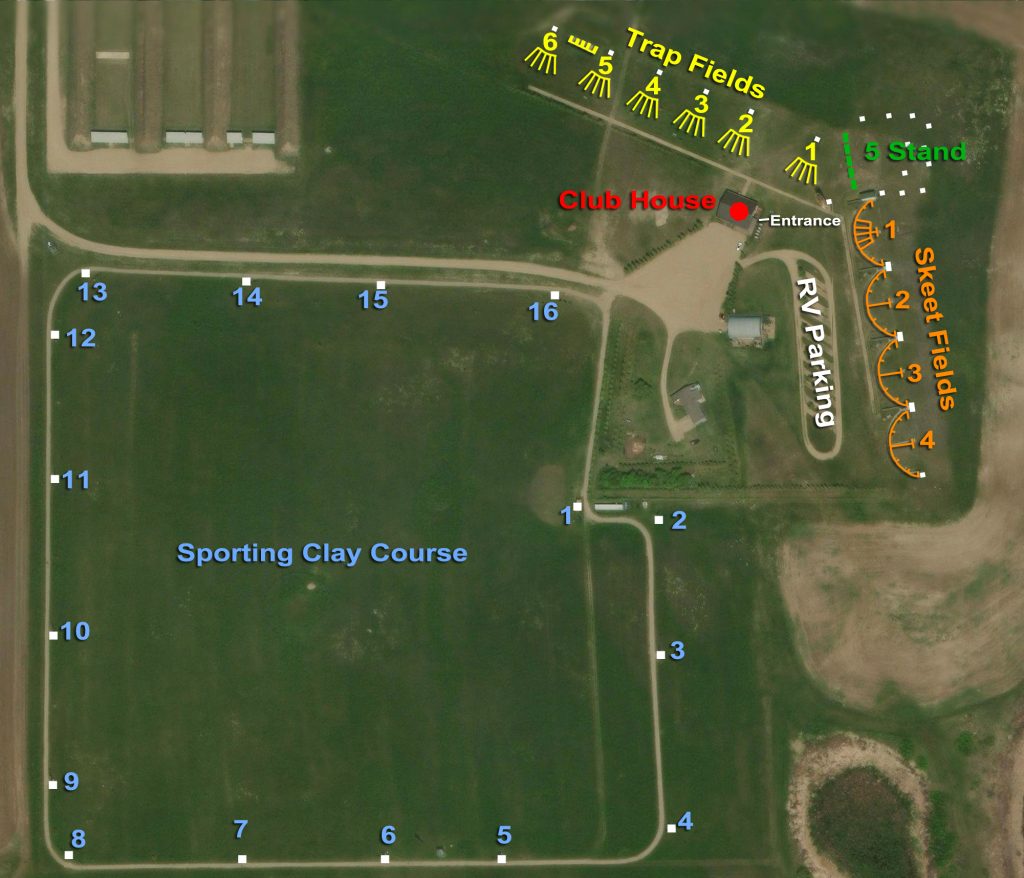
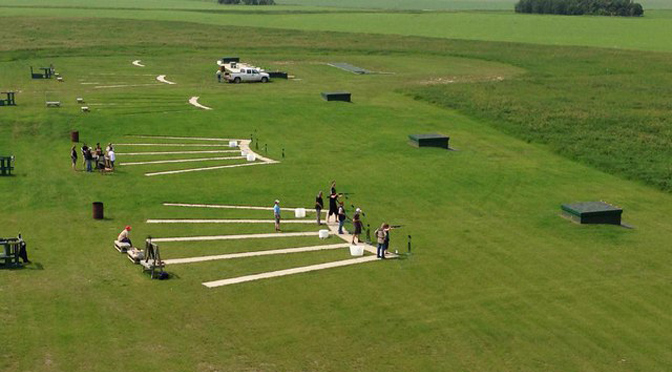
The word “trap” refers to the usage of a trap in which a live bird was placed and released on command and then an attempt was made to shoot it. The earliest printed description of this sport was in Feb. 1793 in England. It became one of England’s most popular sports and migrated to the United States in 1831. The evolution of the sport replaced live birds with glass balls and then clay targets. The clay is called a “bird” and the machine which throws the bird is the “trap” and it is housed in a “trap house”. The shooter is 16 yards behind the trap house, and targets rise and fly away from the shooter. The shooter moves moves in a semi-circle throughout the round to change the angle and difficulty of the going-away shot.
What Constitutes a Round of Trap?
A round for one person consists of 25 shots, five each from five shooting stations, the object being to score the greatest number of broken targets. Most competitions shoot four rounds for a total of 100 targets.
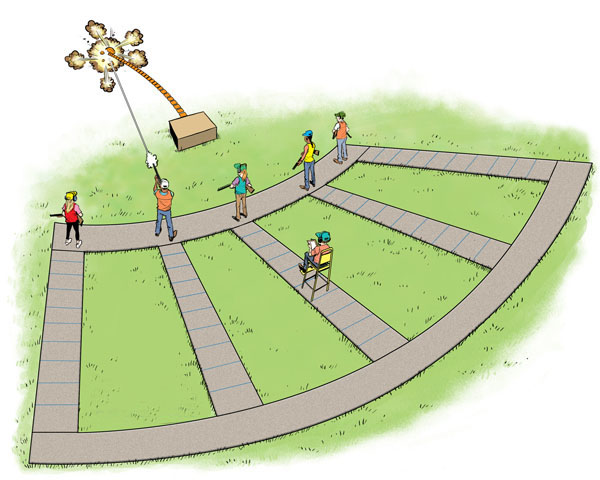
The Layout: Five shooting stations are set up in a semi-circle, 16 yards behind a “trap house” that contains an oscillating target-throwing machine.
The Rotation: Shooters move through all five stations in order. At each station, you take exactly 5 shots (one per target) for a total of 25 shots in a round.
The Target: When you call “pull,” a clay target is launched into the air at about 42 mph, flying away from the shooter at unpredictable angles.
Scoring: Only one shot is allowed per target. If you break the clay, it is recorded as “dead” (even if just a chip falls off); if you miss, it is “lost”.
What is Doubles Trap?
Doubles was added to tournament play in 1911. It is a modified version of Singles, but it is more challenging because shooters must break two targets fired from the trap house simultaneously. One clay pigeon flies to the left while the other flies to the right. The target path remains constant, but the challenge is being able to break both targets before they hit the ground. Each target is scored individually, not as a pair. There are no partners in doubles. Typically, shooters tend to use a shotgun with two barrels, an “over under”, for doubles and one with one barrel for singles and handicap.
Handicap
Handicap is considered the most prestigious event in trapshooting. As in other sports, handicapping strives to make the competition equal. This is accomplished by having the more skilled competitors stand further away from the trap house. Based on a shooter’s past performances, a shooter is assigned a handicap distance which he/she must shoot. A competitor with a high handicap will shoot no closer than the 18-yard line, while the most skilled shooter is placed at the 27-yard line where it is extremely difficult to win an event.
What is International Trap?
International or Olympic Trap is a faster version of the trap game. The targets are thrown about 75% faster than ATA trap. While ATA presentation is ± 22 degrees and only one height – about 2.3 meters, International trap goes ± 45 degrees and the height varies from 1.5 to 3.5 meters. A computer controls the machines so that each shooter gets the exact 25 targets, just in unpredictable order. Each shooter gets two shots at a single target, and moves stations after each shot. Finally the shells are limited to 24 gram of shot (slightly less than 7/8 oz). This is the game one must master to get to the Olympics or other Major games like World Championships, the Pan-Ams or Commonwealth Games.
Currently the Saskatoon Gun Club does not have any International Trap Bunkers.
2026 Saskatchewan Amateur Trapshooting Association (SATA) Registered Shoots
- May 8-10 – Regina
- May 29-31 – Estevan
- June 6-7 – Saskatoon
- June 12-14 – Allan
- June 25-28 – Canadian Championships – Edmonton, AB
- July 3-5 – Swift Current
- July 9-12 – 105th Saskatchewan Provincial Championships – Regina,
- July 24-26 – Kindersley
- Aug 14-16 – Swift Current
- Aug 21-23 – Lloydminster
- Aug 29-30 – Saskatoon
- Sept 5-7 – Allan
- Sept 11-13 – Yorkton
- Sept 12 – Swift Current
- Sept 19-20 – Estevan